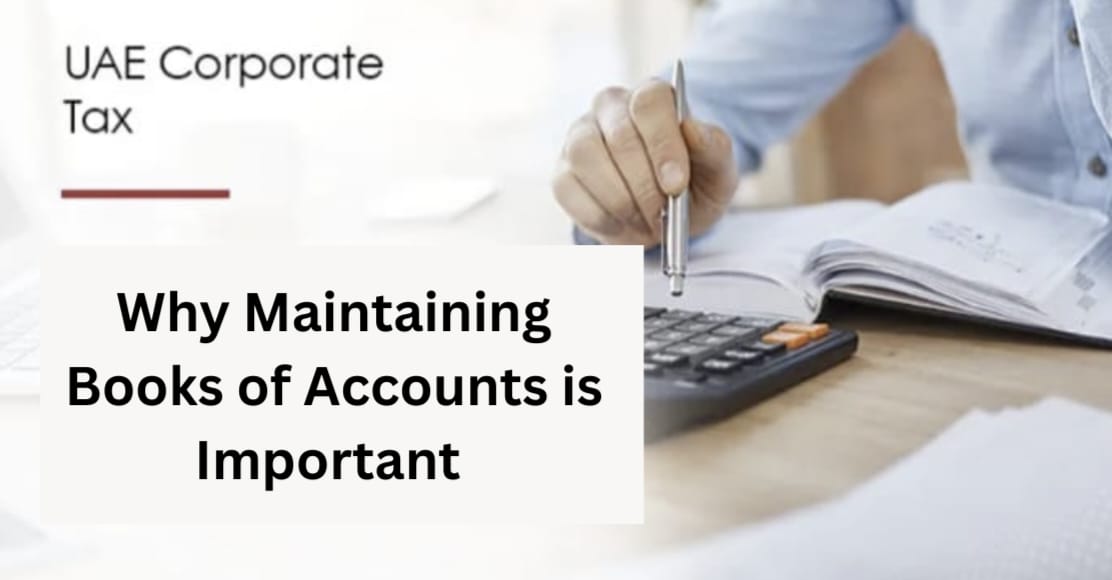
Why Maintaining Books of Accounts is Important in the UAE
In the fast-changing
and highly regulated business environment of the United Arab Emirates (UAE),
keeping accurate books of accounts is not just good practice—it is a legal
requirement.
Whether you're a small
business or a large corporation, maintaining organized bookkeeping is essential
to stay compliant with laws, prepare for audits, and strategically plan for
business growth.
This
blog explains why book keeping matters in the UAE, the latest legal rules, its impact
on VAT and Corporate Tax, and how businesses can prepare for the future through
digital accounting tools.
Legal Requirement Under UAE Laws, Ensures VAT & Corporate Tax Compliance & Enhances Financial Transparency and Decision-Making
1.
Legal Requirement Under UAE Laws :
·
Federal
Decree-Law No. 32 of 2021 on Commercial Companies
·
This law replaced Decree-Law No. 2 of
2015. According to Article 26, companies in the UAE must:
Ø Keep
proper books of accounts that show the company’s financial status.
Ø Retain
records for at least 5 years after the financial year ends.
·
UAE
VAT Law (Federal Decree-Law No. 8 of 2017)
Ø All
VAT-registered businesses must maintain:
v Books
of accounts and related documents for 5 year (or 15 years for real
estate-related transactions).
v This includes:
·
Tax invoices and credit notes
·
VAT return filings and payment records
·
Import/export documentation
·
Communications with the Federal Tax
Authority (FTA)
·
UAE
Corporate Tax Law (Federal Decree-Law No. 47 of 2022)
Ø Effective
for financial years beginning June 1, 2023:
v Taxable
businesses must retain records for a minimum of 7 years.
v These
records should include:
§ Profit
and loss statements
§ General
ledgers
§ Payroll
details
§ Bank
statements
§ Fixed
asset registers
§ Financial
and audit reports
2.
Ensures VAT & Corporate Tax Compliance :
·
Maintaining
accurate records helps businesses:
v Calculate
taxable income properly
v Submit
accurate and timely VAT returns
v Be
ready for FTA audits or inspections
v Reduce
the risk of costly penalties
·
Penalties
for Non-Compliance
v Penalties
may range from AED 10,000 to over AED 50,000, depending on the nature of the
violation.
v Examples
include:
§ Not
keeping adequate records
§ Filing
incorrect VAT returns
§ Missing
corporate tax filing deadlines
3.
Enhances Financial Transparency and Decision-Making :
·
Reliable bookkeeping enables business
owners to:
v Manage
cash flow and working capital
v Monitor
income vs. expenses
v Plan
effective budgets and forecasts
v Make
informed decisions backed by real data
Well-kept financial
records help avoid overspending and pinpoint areas for saving or reinvestment.
Builds Investor and Stakeholder Confidence , Facilitates External Audits and Due Diligence, Supports Daily Operations and Business Continuity , Embracing Digital Bookkeeping (A Key Trend in 2025) & Avoids Legal Disputes and Internal Fraud
4.
Builds Investor and Stakeholder Confidence :
·
If you're looking for funding,
partnerships, or expansion:
v Audited
financial statements are often required
v Good
bookkeeping shows you're trustworthy and compliant
v Clean
records help build long-term confidence with stakeholders
5.
Facilitates External Audits and Due Diligence:
·
Many UAE free zone authorities (e.g.,
DMCC, JAFZA, DAFZA) require companies to submit audited financials annually.
·
Keeping accurate books helps:
v Make
audits smoother and faster
v Lower the cost and complexity of audits
v Prevent
errors and non-compliance during reviews
6.
Supports Daily Operations and Business Continuity
·
Bookkeeping is essential for:
v Processing
payroll and employee benefits
v Settling
vendor and customer payments
v Applying
for loans and credits
v Reconciling
bank statements
v Preparing
for mergers, acquisitions, or liquidation
In cases like company
restructuring or closure, well-maintained books act as legal proof of financial
activity.
7.
Embracing Digital Bookkeeping (A Key Trend in 2025)
·
With the UAE moving towards digital tax
systems, including EmaraTax and future e-invoicing mandates, digitized
accounting is becoming essential.
·
Popular Accounting Platforms in the UAE:
v Zoho
Books
v QuickBooks
v Tally
ERP
v Xero
·
These tools:
v Enable
real-time data entry
v Offer
cloud-based accessibility
v Automate
tax calculations and filing
v Ensure
compliance and reporting accuracy
·
E-invoicing
Update: While the exact timeline is still under
clarification by the FTA, businesses are encouraged to prepare now, as the phased
rollout is expected soon.
8.
Avoids Legal Disputes and Internal Fraud
·
Inadequate or missing records can lead
to:
v Contractual
disputes
v Employee
or partner claims
v Errors
in VAT or tax assessments
v Failure
during audits
v Financial
fraud or misuse
·
Proper bookkeeping ensures:
v Clear
audit trails
v Transparency
in all transactions
v Legal
proof of compliance in disputes
Conclusion:
·
In the UAE, maintaining books of
accounts is more than a regulatory obligation—it is a pillar of financial
integrity and growth.
·
From tax compliance and audit readiness
to funding, budgeting, and fraud prevention, organized bookkeeping empowers
your business at every stage.
·
By implementing professional bookkeeping
practices or adopting reliable accounting software, your business can:
v Stay
compliant with UAE laws
v Build
stakeholder confidence
v Achieve
financial stability and control
v Be
future-ready for digital tax reforms
Related Posts